
Galactic Super Waves and Tsunami Energies Incoming | Milky Way’s Black Hole Shows Signs of Increased Chatter
Thursday, September 24, 2015
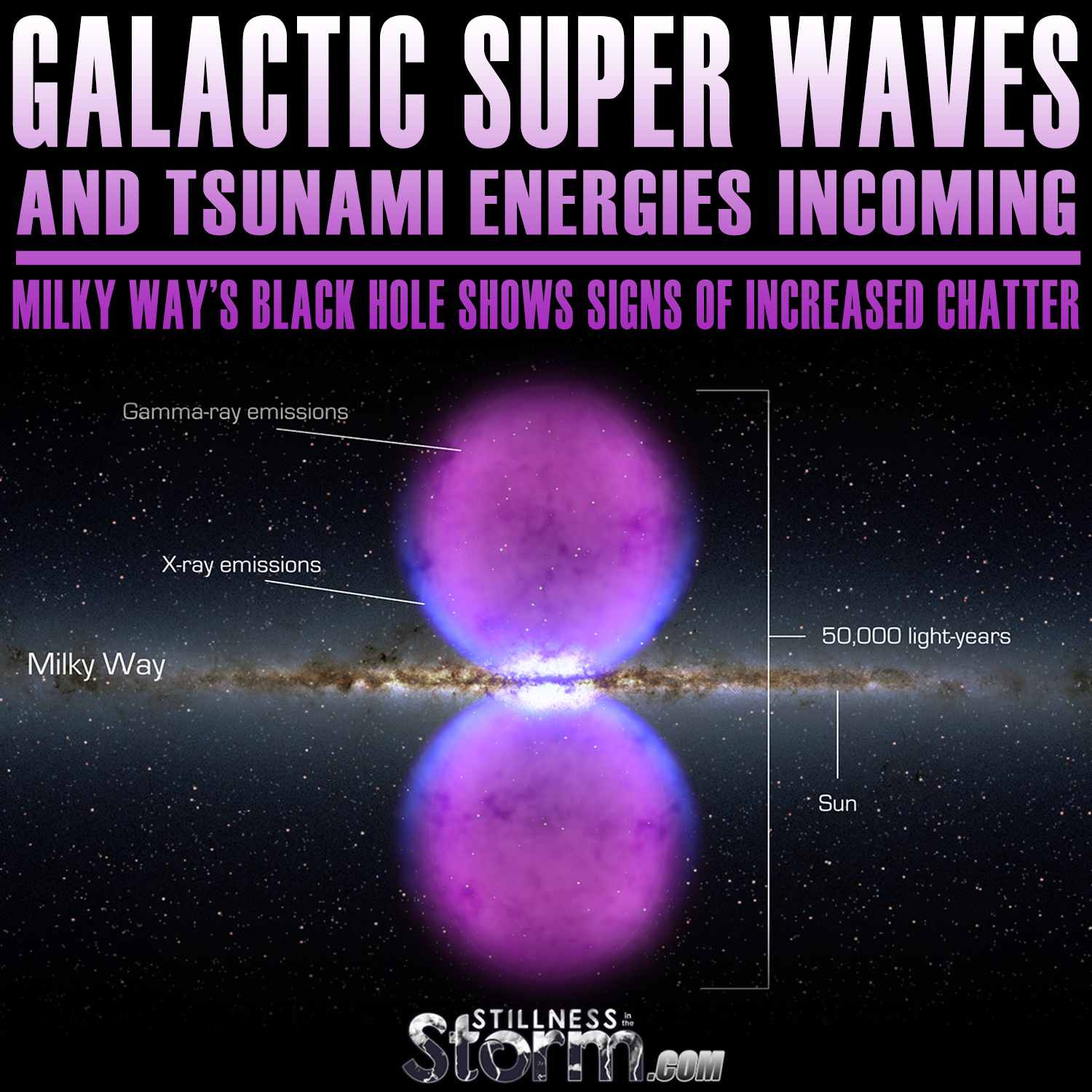
There has been a growing buzz around the topic of so-called Galactic Wave X, as reported by Dr. Simon Atkins, who claims these energy waves will bathe the planet in highly coherent consciousness fields. These fields, as reported by Atkins, will greatly affect human affairs and eventually completely transform life as we know it.
While there is a vast amount of evidence demonstrating that consciousness and life is profoundly affected by solar and galactic activity, there has been no specific evidence released by Atkins to confirm his assertions of a galactic event in late September.
Perhaps this recent article by NASA is one such confirmation, or at the very least, lends credence to the galactic tsunami waves of energy discussed by David Wilcock, Corey Goode, and many other researchers. Here is a brief list of articles, which discuss this topic in greater detail.
Related Summary and Analysis of Cosmic Disclosure Episode 9: Electric Sun | Corey Goode and David Wilcock
Related Science and Evidence For The Transformation of the Solar System | The Divine Cosmos by David Wilcock
The below article by NASA clearly shows how little modern science understands this phenomenon as it relates to the universe at large. But when we consider the theories discussed by Dewey B. Larson (Reciprocal Systems Theory) and Electric Universe, an explanation of the increased x-ray activity is provided.
A ‘black hole’ is a highly active electrical focal point of energy, wherein material that surrounds it discharges as electrical potentials change due to rotational motion. These electrical potentials are actually much more interconnected to the universe at large, in what has been called the Cosmic Webby Corey Goode.
As the galaxy spins about itself, electrically active centers come in close proximity, which produces discharges of energy and changes in the expression of celestial bodies. This ‘mysterious object’ called G2 seems to be electrically active enough to produce discharges within the central sun of our galaxy.
These waves of energy radiate out bathing all the star systems within the galaxy itself, and the energy state of these waves is arguably very coherent, or organized. This energy hits the solar system, causing an entrainment or synchronization such that eventually the base frequency rates of all matter within it are affected.
The sun itself will change it’s energy expression as it synchronizes to these galactic waves, which in turn will affect consciousness in the solar system. This has been clearly documented in the following film by Dieter Broers; a German physicist and researcher.
While NASA scratches their head to come up with a non-electrical explanation, the research of alternative science easily recognizes these changes as part and parcel with a dynamic and interconnected electromagnetic universe.
Possibly the coming months will see increased celestial activity and a resulting change in life as we know it.
Source – NASA


Three orbiting X-ray space telescopes have detected an increased rate of X-ray flares from the usually quiet giant black hole at the center of our Milky Way galaxy after new long-term monitoring. Scientists are trying to learn whether this is normal behavior that was unnoticed due to limited monitoring, or these flares are triggered by the recent close passage of a mysterious, dusty object.
By combining information from long monitoring campaigns by NASA’s Chandra X-ray Observatory and ESA’s XMM-Newton, with observations by the Swift satellite, astronomers were able to carefully trace the activity of the Milky Way’s supermassive black hole over the last 15 years. The supermassive black hole, a.k.a. Sagittarius A*, weighs in at slightly more than 4 million times the mass of the Sun. X-rays are produced by hot gas flowing toward the black hole.
The new study reveals that Sagittarius A* (Sgr A* for short) has been producing one bright X-ray flare about every ten days. However, within the past year, there has been a ten-fold increase in the rate of bright flares from Sgr A*, at about one every day. This increase happened soon after the close approach to Sgr A* by a mysterious object called G2.
“For several years, we’ve been tracking the X-ray emission from Sgr A*. This includes also the close passage of this dusty object” said Gabriele Ponti of the Max Planck Institute for Extraterrestrial Physics in Germany. “A year or so ago, we thought it had absolutely no effect on Sgr A*, but our new data raise the possibility that that might not be the case.”
Originally, astronomers thought G2 was an extended cloud of gas and dust. However, after passing close to Sgr A* in late 2013, its appearance did not change much, apart from being slightly stretched by the gravity of the black hole. This led to new theories that G2 was not simply a gas cloud, but instead a star swathed in an extended dusty cocoon.
“There isn’t universal agreement on what G2 is,” said Mark Morris of the University of California at Los Angeles. “However, the fact that Sgr A* became more active not long after G2 passed by suggests that the matter coming off of G2 might have caused an increase in the black hole’s feeding rate.”
While the timing of G2’s passage with the surge in X-rays from Sgr A* is intriguing astronomers see other black holes that seem to behave like Sgr A*. Therefore, it’s possible this increased chatter from Sgr A* may be a common trait among black holes and unrelated to G2. For example, the increased X-ray activity could be due to a change in the strength of winds from nearby massive stars that are feeding material to the black hole.
“It’s too soon to say for sure, but we will be keeping X-ray eyes on Sgr A* in the coming months,” said co-author Barbara De Marco, also of Max Planck. “Hopefully, new observations will tell us whether G2 is responsible for the changed behavior or if the new flaring is just part of how the black hole behaves.”
The analysis included 150 Chandra and XMM-Newton observations pointed at the center of the Milky Way over the last 15 years, extending from September 1999 to November 2014. An increase in the rate and brightness of bright flares from Sgr A* occurred after mid-2014, several months after the closest approach of G2 to the huge black hole.
If the G2 explanation is correct, the spike in bright X-ray flares would be the first sign of excess material falling onto the black hole because of the cloud’s close passage. Some gas would likely have been stripped off the cloud, and captured by the gravity of Sgr A*. It then could have started interacting with hot material flowing towards the black hole, funneling more gas toward the black hole that could later be consumed by Sgr A*.
A paper on these findings has been accepted by the Monthly Notices of the Royal Astronomical Society. A preprint is available online. NASA’s Marshall Space Flight Center in Huntsville, Alabama, manages the Chandra program for NASA’s Science Mission Directorate in Washington. The Smithsonian Astrophysical Observatory in Cambridge, Massachusetts, controls Chandra’s science and flight operations.
Source:
Galactic Super Waves and Tsunami Energies Incoming | Milky Way’s Black Hole Shows Signs of Increased Chatter
 saintandrewstwinflame