
Swiss Government Proposes Paying Everyone £1,700 a Month
 Swiss government proposes paying everyone £1,700 a month whether they work or not in a bid to end poverty… but insists most people will still want to get a job
- Swiss residents to vote on referendum to guarantee basic monthly income
- It would be first country in the world to introduce unconditional income
- Radical plan was proposed by group of intellectuals
By Gianluca Mezzofiore For Mailonline, 29 January 2016
Swiss residents are to vote on a countrywide referendum about a radical plan to pay every single adult a guaranteed income of £425 a week (or £1,700 a month).
The plan, proposed by a group of intellectuals, could make the country the first in the world to pay all of its citizens a monthly basic income regardless if they work or not.
But the initiative has not gained much traction among politicians from left and right despite the fact that a referendum on it was approved by the federal government for the ballot box on June 5.
Swiss residents could get a guaranteed monthly basic income of £1,700 a month regardless if they work or not
Swiss residents could get a guaranteed monthly basic income of £1,700 a month regardless if they work or not
The radical plan also proposes that each child receives £100 a week
The radical plan also proposes that each child receives £100 a week
Under the proposed initiative, each child would also receive 145 francs (£100) a week.
The federal government estimates the cost of the proposal at 208 billion francs (£143 billion) a year.
Around 153 billion francs (£105 bn) would have to be levied from taxes, while 55 billion francs (£38 bn) would be transferred from social insurance and social assistance spending.
The group proposing the initiative, which includes artists, writers and intellectuals, cited a survey which shows that the majority of Swiss residents would continue working if the guaranteed income proposal was approved.
‘The argument of opponents that a guaranteed income would reduce the incentive of people to work is therefore largely contradicted,’ it said in a statement quoted by The Local.
However, a third of the 1,076 people interviewed for the survey by the Demoscope Institute believed that ‘others would stop working’.
And more than half of those surveyed (56 percent) believe the guaranteed income proposal will never see the light of day.
Read more: http://www.dailymail.co.uk/news/article-3422775/Swiss-government-proposes-paying-1-700-month-work-not-bid-end-poverty-insists-people-want-job.html#ixzz3ywDJBfi7
Follow us: @MailOnline on Twitter | DailyMail on Facebook


FROM THE FIRST ORDER;
The “AVERAGE HUMAN CAN GO ABOUT A WEEK WITHOUT FOOD,” BEFORE the BODY starts to REACT,But happens AFTER when the first week is up?
“HOW LONG DO YOU THINK, YOU CAN GO WITHOUT FOOD?”
QUESTION is, “HOW MANY PEOPLE WILL STARVE to DEATH BEFORE JUNE 2016?”
**************************************************************************
Opposition leaders arrive for peace talks in Switzerland as more Syrians starve

Geneva, Jan 31: Representatives of Syria’s main opposition body arrived in Switzerland on Saturday for UN-organised peace talks as the starvation death toll rose in Madaya, one of a string of besieged towns in the war-ravaged country. The High Negotiations Committee (HNC) begrudgingly bowed only late Friday to US and Saudi pressure to at least show up in Geneva to test the waters for joining the biggest push yet to end a five-year-old civil war.
But, the body insists it will not engage in formal negotiations, even indirectly, with President Bashar al-Assad’s regime until UN Security Council resolutions requiring an end to sieges of towns are adhered to. ”We will not sit down at the negotiating table if our people continue to be massacred,” HNC spokesman Salem al-Meslet said on Saturday. It is also pressing for bombardments of civilians to cease. Highlighting the dire situation, Doctors Without Borders (MSF) said 16 more people had starved to death in Madaya, with several dozen more residents in “danger of death” because of severe malnutrition. (ALSO READ: Jordan PM links Syrian refugee admissions to foreign aid)
Madaya is one of four towns included in a rare deal last year intended to halt fighting and allow in humanitarian aid, but access remains limited both there and in the rebel-besieged towns of Fuaa and Kafraya. On Friday, the scheduled start of a planned six months of talks under an ambitious roadmap set out in Vienna in November, protesters highlighted the plight of ordinary Syrians with “siege soup” of grass and leaves. More than 4.5 million people with immense humanitarian needs are living in areas extremely hard to access because of fighting, the International Committee of the Red Cross (ICRC) said 0n Saturday.
A source close to the HNC said that the group was sending 17 negotiators and 25 others to the Swiss city. A 16-member delegation representing Assad’s government arrived on Friday. Backed by external powers embroiled in Syria’s war, the talks are seeking to end a conflict that has killed more than 260,000 people and fuelled the meteoric rise of the extremist Islamic State group. Millions of those fleeing the conflict have sought refuge in neighbouring countries and hundreds of thousands have risked their lives to reach Europe.
Dozens of migrant men, women and children, including Syrians, drowned on Saturday when their boat sank off of Turkey — joining the almost 4,000 who died trying to reach Europe by sea in 2015. The influx has also created tensions in Europe. Dozens of masked men believed to belong to neo-Nazi gangs carried out a number of assaults on migrants in Stockholm overnight, police said Saturday. The complexities of the Syrian conflict, involving a tangled web of moderate rebels, Islamist fighters, Kurds, jihadists and regime forces backed by Moscow and Iran, pose a huge challenge to the talks, experts say.
****************************************************************
http://www.aljazeera.com/news/2016/01/160130122259213.html
Madaya residents starving to death despite aid delivery
Doctors Without Borders says 16 people have died in the besieged town despite provision of aid in convoys.
Residents of the besieged Syrian town of Madaya continue to die of starvation and a lack of medical supplies, despite the delivery of aid earlier this month, according to a leading humanitarian agency.
Doctors without Borders (MSF) said on Saturday that at least 16 people – close to one person per day – have died since three aid convoys entered the town, near the Lebanese border, on January 11.
The group said that an estimated 320 people in Madaya are suffering from malnutrition, 33 of whom are “are in danger of death if they do not receive prompt and effective treatment”.
“It is totally unacceptable that people continue to die from starvation, and that critical medical cases remain in the town when they should have been evacuated weeks ago,” said Brice de le Vingne, MSF’s director of operations.
Devastating conditions
 |
Rebel-held Madaya has been under siege by government forces and Hezbollah fighters since July.
Harrowing images of malnourished Madaya residents gripped the world in early January, showing wide-eyed babies without access to milk, and elderly men with cavernous rib cages.
“We would go for three days without food, then we would go and gather grass to just boil and eat it,” Mubarak Aloush, a Madaya resident who managed to escape to Lebanon told Al Jazeera at the time.
MSF said that 32 people have died from severe acute malnutrition since December, warning that the town urgently needed emergency aid and permanent medical staff.
“There needs to be a permanent and independent medical presence in Madaya immediately, as we expect the medical situation to worsen as access to healthcare for people inside remains extremely limited,” said De le Vingne.
READ MORE: ‘We are living on water and salt’
Up to two million Syrians are trapped in sieges by the government or by opposition groups, the group said, adding that in many of these areas, medical evacuations are prevented, and necessities like drugs and food are “repeatedly blocked” at checkpoints.
“As a result, medical teams in these areas simply cannot cope with the demands they face. The situation in Madaya is even worse as there are no doctors present in the town,” MSF said.
Humanitarian measures
UN Secretary-General Ban Ki-moon has previously warned that the use of starvation as a weapon in Syria amounted to a “war crime“.
“All sides, including the Syrian government, which has the primary responsibility to protect Syrians, are committing this and other atrocious acts prohibited under international humanitarian law,” he said shortly after the second international convoy in Madaya on January 14.
READ MORE: Syria opposition en route to crunch Geneva peace talks
A delegation representing Syria’s main opposition bloc was travelling to Switzerland on Saturday to assess the intentions of the Syrian government in implementing humanitarian measures that could allow it to join political negotiations.
The talks at the UN headquarters in Geneva are the first since two rounds of negotiations collapsed in 2014.
Syria’s conflict has killed more than 250,000 people, displaced millions and sent hundreds of thousands fleeing as refugees to Europe.
Source: Al Jazeera
******************************************************************
http://www.theguardian.com/world/poverty-matters/2012/oct/05/jean-ziegler-africa-starve
‘We let them starve‘
The former UN food envoy explains his claim that we are all accomplices in creating a world where children starve to death – in a confrontational interview with Swiss media
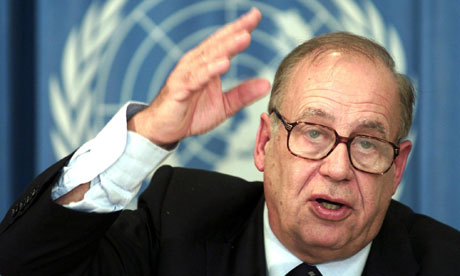
Jean Ziegler was until recently (2000-2008) the United Nations Special Rapporteur on the Right to Food, and subsequently, in a similar function, he served on the Advisory Committee to the UN Human Rights Council. He is also a vocal critic of global capitalism’s effects on the developing world, especially Africa.
The last few days he has been doing the media circuit promoting his new book, “Mass Destruction: The Geopolitics of Hunger” (the French title) or “We Let Them Starve: The Mass Destruction in The Third World” (the German title). There’s no English title available yet.
Ziegler is a well-known Swiss author and politician — his writing is prolific and ever since his first publication (Sociology of the New Africa, 1964), he has taken on the cause of the developing world, against imperialism, capitalism, and injustice. In 1964, as a young academic, he chauffeured Che Guevara around Geneva when the Cuban revolutionary visited the UN.
His combative and at times polemical style has earned him much admiration, but also vilification, and legal persecution. As a socialist member of the Swiss parliament, he particularly attracted the ire of Switzerland’s liberal-conservatives, closely related to big business, and of course the major Swiss banks, for denouncing their hiding away of stolen funds, such as those of former dictator Mobutu Sese Seko of Zaire, of those of Jewish people who perished in the holocaust, and of all kinds of dubious origin that ended up in Swiss banks.
While his fighting spirit, his relentless engagement for justice across the world, and his international standing have earned him respect, he has remained a thorn in the side of Switzerland-based businesses (such as Nestlé) who he has accused of active participation in practices that kept developing countries poor and dependent.
With this in mind, it is then quite understandable that business journalist Philip Löpfe’sinterview with Ziegler for newsnet, the online presence of the Swiss newspapers Basler Zeitung and the Zürich-based Tages-Anzeiger, would be a challenging affair. And yet, the combative and perhaps provocative personality of Ziegler and his engagement with poor countries alone do not fully explain the nature of the questions he faced. Rather, Löpfe’s questions seem to reflect the same strained arrogance as those whose profiteering from global misery was usually explained away as natural and which has now, as global neoliberalism struggles and inequalities become more glaring, been opened up to closer scrutiny and contestation.
Some excerpts from the interview, which I translated from the German:
Ziegler: According to the UN World Food Programme, there is enough food in the world for 12 billion people. If today people are still starving, then this is organized crime, mass murder. Every five seconds, one child under the age of ten dies, one billion people are permanently and heavily undernourished.
Löpfe: [Your] book’s title is “We let them starve”. I am not aware that I let anyone starve.
Ziegler: That is true, but we are all accomplices. We allow multinational food corporations and speculators to decide every day who is eating and living, and who is starving and dying.
Löpfe: What should the individual do? Donate money? Eat less meat?
Ziegler: It is mainly about becoming politically active in order to put an end to the murderous activities of food speculators and multinationals. We can do so, we live in a democracy.
Löpfe: Food speculation has existed for thousands of years. What is wrong when a farmer seeks insurance against bad harvests or when a baker ensures that his supply of flour is stable?
Ziegler: Nothing. But that is not the point … The commodities market was ‘financialised’. Speculators are making billions, while millions of people starve to death.
[…]
Löpfe: How could we avoid such speculation?
Ziegler: We could exclude all non-producers and non-consumers from the commodities exchange – in this sense only the farmer and the baker, through the commodities exchange, engage in trade with each other.
Löpfe: However, the experts have agreed that during emergencies, such as droughts and floods, and so on, commodities exchange and trade should remain open. It was disastrous that during the famine of 2008 some countries blocked the export of rice.
Ziegler: Famines, such as in 2008 and 2011, are additional disasters; they add to the daily massacre of hunger, the so-called ‘silent hunger’. It is true that at the time rice exporting countries such as Thailand and Vietnam closed their borders. Governments were afraid of riots in their own countries. That is understandable. But for a country like Senegal, importing 75% of its rice, it was a disaster.
Löpfe: Why is a country like Senegal forced to import rice? The majority of its population are still subsistence farmers.
Ziegler: It remains a fact that in terms of percentage of the population, there are no more starving people anywhere than in Africa. About a third of the population’s men, women and children are permanently undernourished.
Löpfe: Could one not argue in a provocative way that Africa is not starving because of the speculators but because it is too poor for the speculators: there is nothing to be earned there.
Ziegler: No, no. African countries have incredible civilisations, based on agriculture, with much knowledge and very fertile soils.
Löpfe: Why is it that Africa is the continent where most people starve and which imports more than a quarter of its food supply?
Ziegler: Because the colonial pact is still enforced.
Löpfe: Isn’t this a bit too simple? Colonialism has been over for more than half a century.
Ziegler: But there still is a small upper class, dependent on rich countries, and extremely corrupt. Again Senegal: The country exports peanuts and at the same time imports three quarters of its food requirements.
Löpfe: Why?
Ziegler: Because the colonial pact was never broken. The Senegalese farmers are forced to grow and exports peanuts because the revenue serves to pay for foreign debt. At the same time, Europe sells its food surplus at dumping prices on the African markets. How can a small farmer survive under these conditions?
Löpfe: African farmers are not very productive. Their productivity is less than 10 percent of Europe’s agriculture. Are they not just lazy?
Ziegler: On the contrary. Nobody works harder than farmers in Africa. They just cannot thrive because they are not supported: no irrigation, no seed, no draft animals, no tractors, no fertilizer, nothing.
[…]
So there you have it. Like the now jobless Greeks, if only those poor people weren’t so lazy…
But there is more to this story. Löpfe’s ‘provocative’ questions — especially his last one — might be seen as a thinly disguised nod to the media owners who have recently acquired one of the papers in which the interview was published.
Georges Bindschedler, co-investor in the rather cynically called ‘Medienvielfalt Holding’ (Media Diversity Holding) makes it clear why it was necessary to acquire the newspaper.
In an interview last year, he elaborated on their ‘mission’. He suggests that the ‘liberal music’ is not heard loud enough in the Swiss media landscape, and hence Swiss voters fail to understand important political issues, and vote the wrong way, one might add. In particular, he was referring to the rejection by Swiss voters of the rationalisation of a national health care system earlier this year, which according to some analysts would have led further down the slippery slope to a two-tier system – one for the rich, and one for the poor.
As everywhere in the world, corporate control of the media is not about safeguarding the diversity of opinions, as he claims, but about propagating more neoliberal, pro-business values and ideas.
Perhaps it is a sign of the times that even in Switzerland, the sheltered island of wealth and prosperity, neoliberal capital feels the need to step up its propaganda efforts.
• This article was amended on 11 October 2012. The original said that the Swiss newspapers Basler Zeitung and Tages-Anzeiger were both owned by holding companies in which the business tycoon Tito Tettamanti controlled the majority of shares. That is not true of the Tages-Anzeiger.
 saintandrewstwinflame