
Draco’s, Nazi’s and Khazarian’s Officially Surrender
A song to accompany while reading this. Enjoy! ~ Dinar Chronicles
Remember to read between the lines. ~ Dinar Chronicles
Draco Surrender
—
Kremlin comments on Kissinger’s role in arranging Putin-Trump meeting
June 30, 14:09UTC+3
Henry Kissinger, 94, held the post of the US national security adviser in 1969-1975 and worked as the US Secretary of State in 1973-1977

Former US Secretary of State Henry Kissinger© Stanislav Krasilnikov/TASS
MOSCOW, June 30. /TASS/. Former US Secretary of State Henry Kissinger did not try to become a mediator to arrange a meeting between Russian and US Presidents Vladimir Putin and Donald Trump, Kremlin Spokesman Dmitry Peskov said on Friday.
“No, he didn’t try, this wasn’t so,” Peskov told reporters.
Peskov gave no details about Putin’s meeting with Kissinger on Thursday. “This is an absolutely private meeting,” he said, noting that Kissinger is in Moscow to take part in Primakov Readings, a summit of experts, diplomats and politicians in memory of Russian outstanding statesman Evgeny Primakov.
The meeting was held “as a follow-up to the old years-long contacts,” Peskov said. “Traditionally, the president and the ex-Secretary of State use these coinciding schedules for holding personal meetings,” he said.
Kissinger, 94, held the post of the US national security adviser in 1969-1975 and worked as the US Secretary of State in 1973-1977. He is one of the ideologists of the detente policy in relations between the US and the Soviet Union. Kissinger was awarded the Nobel Peace Prize for his role in concluding the Paris Agreement to end the war and restore peace in Vietnam.
Putin and Kissinger have held more than a dozen meetings. Before Thursday’s talks they met on February 3, 2016.
Source: TASS
______________________________________________________
Nazi Surrender
—
Putin, Merkel discuss topics of forthcoming G20 summit
June 30, 20:37UTC+3
Putin and Merkel also touched upon issues of the Paris agreement on climate change and a number of aspects of bilateral cooperation
MOSCOW, June 30. /TASS/. Russian President Vladimir Putin and German Chancellor Angela Merkel discussed topics of the forthcoming Group of Twenty summit, the Kremlin press service said on Friday.
“Ahead of the Group of Twenty summit in Hamburg (July 7-8, 2017), the leaders discussed key topics of the forum’s agenda,” the press service said.
Apart from that, Putin and Merkel touched upon issues of the Paris agreement on climate change and a number of aspects of bilateral cooperation.
The conversation was initiated by the German side.
Earlier, Russia’s G20 Sherpa, Svetlana Lukash, said that ahead of the G20 summit in Hamburg Germany’s presidency in the Group of Twenty was still agreeing the Group’s common position on climate change in the light of US’ recent decision to withdraw from the Paris deal. She also said that climate change will be among top priority issues during the leaders’ discussions.
Paris climate deal
The Paris agreement on climate change was adopted on December 12, 2015, following a conference in the French capital. A total of 195 participants in the forum agreed on preventing average temperatures on Earth from rising by more than 2 degrees Celsius by 2100 compared to the pre-industrial epoch.
By now, twenty-six countries have ratified the deal. On June 1, 2017, US President Donald Trump announced about the US decision to quit the agreement.
Source: TASS
______________________________________________________
Khazarian Surrender
—
What’s Behind Israel’s Diplomatic Flare-Up With Russia
After years of reported airstrikes in Syria, the Israeli ambassador in Moscow was suddenly summoned to explain his country’s recent attack.
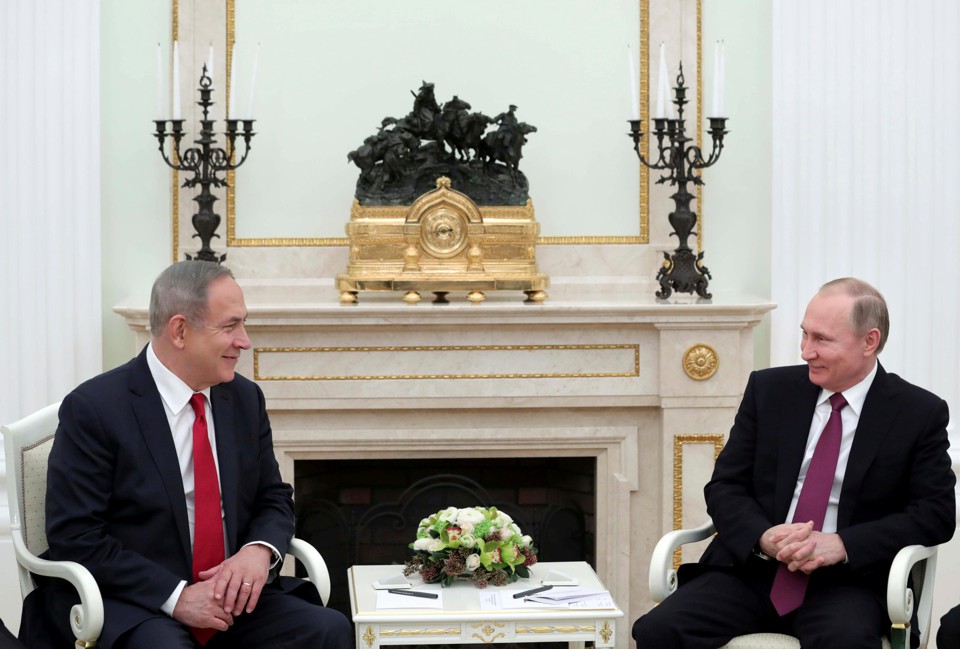
Mikhail Klimentyev / Kremlin
ADAM CHANDLER
MAR 24, 2017
In the fall of 2015, Russia and Israel held their first talks on “deconfliction,” a disconcerting, vague military arrangement, the aim of which was “preventing misunderstandings” in the Syrian civil war. Russia had just formally entered the conflict, and Israel had already been informally participating through occasional strikes on Hezbollah targets in Syria and some cross-border exchanges of fire. The purpose of deconfliction, it seemed, amounted to a diplomatic version of Ma$e rules: Stay out of my way.
But late last week, something changed. As Israeli jets returned from Syria after bombing a weapons convoy reportedly bound for their foe Hezbollah—allied with Syrian dictator Bashar al-Assad and Iran—Syrian forces fired missiles at them, sparking the most serious incident between the two countries in the six-year war. In a first, the Syrian anti-aircraft missiles triggered Israel’s missile defense system, which intercepted one of the rockets, causing debris to fall over neighboring Jordan. Last Friday, following the incident, an Israeli army official confirmed the Israeli strike on the convoy publicly for the first time.
Shortly after the episode, Russia took the unusual step of summoning the Israeli ambassador in Moscow to explain what happened. This may have had to do with the Israeli admission or the strike itself; according to one Israeli report, Russian troops were reportedly stationed not far from where the Israeli jets struck in Syria. However, Syria’s unprecedented military response could suggest that the dynamic is shifting, as pro-Assad forces continue to gain ground with Russian and Iranian help and as a new U.S. administration slowly settles in—leaving Israel uncertain of its place in the conflict.
Despite its conflicting priorities, Israel, which wants to keep Iran out of Syria and Hezbollah weak, has managed to keep solid working relations with Russia through the Syrian conflagration. But, as the war progresses, those days may be over. “No matter how good the coordination mechanism between the two sides,” writes Michael Koplow of the Israel Policy Forum, “the fundamental conflict at the heart of Israeli-Russian views on Syria is that Israel’s redline is the establishment of a permanent Iranian presence in Syria and Russia’s redline is the elimination of a permanent Iranian presence in Syria.”
On Sunday, the Syrian ambassador to the UN warned that his government’s response to the Israeli strikes marked a new phase of the conflict, where Israeli attacks would merit further responses. He also claimed that Russia had informed Israel that it no longer had free rein to do what it wishes in Syrian airspace. In a series of tweets on Monday, Daniel Shapiro, the former U.S. ambassador to Israel under President Obama and an Atlantic contributor, suggested that the Israeli-Syrian border may be where Russian President Vladimir Putin decides to test how much leverage he has in the Middle East with President Trump in power.
The Israelis, for their part, vehemently deny that they have been constrained from conducting strikes in Syria. On Sunday, Israeli Defense Minister Avigdor Lieberman vowed to destroy Syria’s air defense system if Israeli jets ever encountered return fire again. On Tuesday, Israeli Prime Minister Benjamin Netanyahu told reporters in Beijing, “It’s simply incorrect to say the Russians are changing their policy toward us.”
Despite Netanyahu’s exhortations, there’s no guarantee that Russia will maintain its tacit agreement with Israel over its activities in Syria, especially as Assad’s prospects only continue to brighten. Should Russia change its mind and tell Israel to cease its activities in Syria, the cost of future Israeli strikes will go up, leaving Bibi with fewer options. He could turn to the U.S. for sympathy—something he may not find within the new administration.
In the meantime, tensions between Israel and Syria continue to escalate. On Sunday, an Israeli drone strike reportedly killed a high-ranking air defense official in the pro-Assad forces. On Monday, Israel confirmed that one of its drones had been shot down in Syria. And, on Wednesday, Syrian opposition outlets reported that Israeli jets had carried out new strikes near Damascus, the fourth such attack in less than a week. Israeli officials declined to comment.
Source: The Atlantic
http://inteldinarchronicles.blogspot.ca/2017/07/dracos-nazis-and-khazarians-officially.html
 saintandrewstwinflame